Tuesday, July 27, 2010

CSA Week 9

Your farmers went camping this weekend. Along with some other friends who are also farmers we hiked in the woods and we built a fire and at night we fell asleep to the sound of a gentle rain against the canopy of trees and against our tents. It was a good weekend, and it was significant because it is rare that we both take two days off in a week, and it is rare that we so fully leave the context of the farm during the season. We spend a lot of time here, and I was reminded this weekend that it is easy to lose perspective of your surroundings while you are immersed in them. To leave--to walk away into the woods--provides an opportunity to return with refreshed awareness and see the place you left as if it is new. Growth and change are constant on the farm, but they are easy to miss when they are constantly before your face. Leave for a weekend, though, and the profusion of new plant life--weeds and flowers and vegetable crops alike--is startling. Its like when you were younger and your grandmother would visit from the midwest and even though you didn't feel any taller she would always greet you with her favorite pun: You gruesome! We're back, refreshed, and most things on the farm grew some in our short absence. The squash harvest was particularly epic this morning, but do you think those plants noticed how large and profuse they'd become? Probably not, they didn't leave themselves for a minute.

Here's what is in the share this week:

Beets, red
Onions, ailsa craig
Broccoli, gypsy
Summer Squash
Zucchini
Cucumbers
Lettuce
Cilantro
Parsley

Notes about the food:
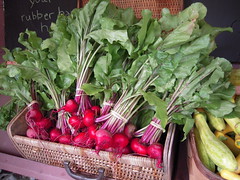
chioggia beets


*Friend of the farm Sadie Ryn Miller made a delicious beet salad, and she shared the recipe:

Trim, salt and oil one bunch of beets. Add a centimeter of water to a baking dish, add beets, cover with a lid or aluminum foil, and roast at 350 degrees for 1 1/2 hours. Peel the beets under running water while they are still warm so that the peels slide off between your fingers. Marinate in vinaigrette (red wine vinegar, olive oil, mustard, salt and pepper). Serve with fresh greens, nuts and goat cheese. Fresh figs and pistachios are perfect additions.

*Sometimes I would like to spend all day eating baked goods. If you'd like to incorporate some vegetables into dessert, try these recipes--One uses summer squash for something sweet, the other uses beets:

Summer Squash "Apple Crisp" (From another friend of the farm.)

6-7 cups zucchini or other summer squash
3/4 cup lemon juice

Peel, seed, and chop squash into slices. Combine with lemon juice and cook on the stovetop until slightly translucent. Remove from heat and add:

1 tsp nutmeg
1/2 cup sugar
2 tsp cinnamon

Stir and pour into a baking dish. Top with:

1 1/3 cups brown sugar
1 cup flour
1 tsp nutmeg
1 cup oats
2/3 cup butter

Bake at 375 until golden and bubbly.

Chocolate Beet Cake (From Farmer John's Cookbook.)

4 oz. unsweetened chocolate
1 cup vegetable oil
3 eggs
1 3/4 cups sugar
2 cups beets, cooked and pureed
1 tbsp vanilla extract
1 1/2 cups all purpose flour
1/2 cup whole wheat pastry flour
2 tsp baking soda
1/4 tsp salt
powdered sugar

Preheat oven to 375. Coat a 10 cup bundt pan with oil and dust with flour. Partially fill bottom of a double boiler with water and bring to a boil over high heat, then reduce to a simmer. Put the chocolate and 1/4 cup of the oil in the top half of the boiler. Heat just until the chocolate melts, then remove from heat and stir until combined. Combine eggs and sugar in a large bowl and beat with an electric mixer until fluffy. Slowly beat the remaining 3/4 cups oil, chocolate mixture, pureed beets and vanilla. Sift the all-purpose flour and whole wheat pastry flour into a bowl. Stir in baking soda and salt. Gently stir the flour mixture into the egg and chocolate mixture just until the flour is mixed in. Don't over mix. Pour batter into prepared pan and bake until a toothpick comes out clean, about 45 minutes. Cool on wire rack for 30 minutes. Remove cake from pan and continue to cool on wire rack. When completely cool, dust with powdered sugar.

*Broccoli, like other vegetables in the brassica family (kale, cabbage, etc.), is a cool weather crop, and the fact that we successfully grew well-formed heads of the stuff in the middle of this hot summer is somewhat baffling to us. We planted it without real expectation, and then watched as it thrived. Remember to eat the stem and leaves along with the florets: much of the plant's nutrition is contained in those parts, and they are just as tasty.

Tuesday, July 20, 2010

CSA Week 8

I know that summer begins the third week of June and lasts until the third week of September, but my mental calendar conforms more closely to the school vacation period that has not been a part of my life for many years. By that reckoning summer neatly occupies the three months June-August and now, mid-July, is the season's halfway point. We're a ship in the doldrums, or a ship that is moving, but is moving across open sea, from a horizon of water toward a horizon of water, so that our motion is imperceptible and repetitive. Spring and fall are times of palpable change, and it is true that alongside these summer can feel like a static season, but I would do the garden a disservice to ascribe to it my own interior summertime state. There are buoys in this ocean: they are colorful and flavorful and impossible to miss. Our tomatoes have begun to ripen--not enough to fill a week of CSA shares, but enough that we were able to put the first sungold cherry tomatoes at the farmstand today. And the first deep-purple globes of eggplant have made their appearance. As these crops mature, the last of our spring crops have slowed in the heat. Once they are certified moribund, we rototill them, and our first plants of the season are returned to the soil. The effect on the farm's landscape is instantly noticeable: beds that were full of crops and their accompanying weeds are erased, and their green height and texture are replaced with the level brown of unplanted soil. Change on the farm is constant. For those of us stalled in the midst of an ongoing summer, it's an important thing to remember.

Here is what's in this week's share:

Cabbage, farao -or- napa
Beets, red -or- chioggia
Carrots
Radishes, easter egg
Lettuce
Kale, red russian
Summer Squash
Zucchini
Scallions
Dill
Specialty Basil, cinnamon -or- lemon
Raspberries, pick your own

Notes about the food:

*The cabbage took its time forming heads. As the weather got hotter and the cabbage still wasn't ready to harvest, we began to think that the crop would be killed by the heat before it fully matured. But it's ready this week, and not a day too soon; not even at our most optimistic would we expect cabbage--a cool weather crop--to survive another seven days of summer. Try this easy-to-prepare cabbage salad, which Epicurious recommends serving alongside a beet salad, the recipe for which is also below:

Cabbage salad:
1/4 cup white vinegar
1 tbsp soy sauce
1 tbsp sugar
5 tbsp safflower oil
6 cups very thinly sliced green cabbage
2 tbsp fresh chopped mint

Whisk vinegar, soy sauce, and sugar in a large bowl. Gradually whisk in oil. Mix in cabbage and mint. Season with salt and pepper. Let stand 30 minutes (and up to 2 hours) at room temperature, tossing occasionally.

Beet salad:
2 tbsp sherry wine vinegar
2 tsp Dijon mustard
5 tbsp safflower oil
3 large raw beets, peeled, coarsely grated

Whisk vinegar and mustard in large bowl. Gradually mix in oil, then mix in beets. Season with salt and pepper. Let stand at room temperature 30 minutes (and up to 2 hours), tossing occasionally.

*This is the last kale of the summer. One of the three kinds of kale we grow has been in every box so far, and it will return in the fall, but like cabbage (to which it is closely related) kale is not a warm-weather crop, and we've harvested it for as long as we can into the summer. We planted our first round of fall kale last week, and the second round has just germinated in the greenhouse.

Tuesday, July 13, 2010

CSA Week 7

I was once told by a friend with whom I was in regular written correspondence that I wrote beautiful letters, but that they were only about the weather. The second half of that claim was likely true: I have been working in the outdoors for many years, and when a person spends the majority of their time under the sky it is easy to become fixated on all things atmospheric. As farmers, we are especially attuned to fluctuations of temperature and precipitation not only because they affect the success of our work, but because, like our crops, we live in the weather as it occurs, and we work in all of it. There is nothing as immediate as the heat of a hot day, and it is a wiser person than myself who can exist in that stifling immediacy and be mindful of the fact that as oppressive as it is on a given day, it is fleeting compared to the span of season. That person would probably write of something other than the weather, but I'm a simple thing: I write what's on mind, and what's on my mind is what I feel on my skin, and what I feel on my skin is what's in the air. All of which is a way of acknowledging the fact that I always seem to start these blog entires with a paragraph about the weather. Sorry. This week's entry: It is still hot but not as hot as last week, and we appreciated the heavy rains on Saturday. It is possible, if we choose to be fully optimistic, that the extreme heat tempered by regular infusions of water will be very good for many of our crops.

Here's what is in the share this week:

Lettuce
Kale, green curly
Swiss Chard
Turnips, hakurei
Carrots, bolero
Onions, ailsa craig
Summer Squash
Zucchini
Basil, genovese
Parsley
Raspberries, pick your own

Notes about the food:

*Our soil had become very dry prior to Saturday's rain, and when the rain fell, it fell fast and heavy. In such dry conditions it takes time for the water to infiltrate the surface of the soil; before the soil is saturated the pummeling rain splashes against the dry ground, and soil is thrown by the splashing water. As a result, some of our crops are spackled with dirt following such a rain. We wash everything we harvest before arranging it at the distribution stand, so this isn't something you'll notice except on the occasional item that we don't wash. Among the items harvested this week, we wash neither the summer squash nor the basil. These two plants don't store well after becoming wet, so once they are cut we keep them dry even though they are slightly gritty. We recommend that you store them as they are, and wash them just prior to use. Maybe you'll use the basil to make pesto:

4 cups fresh basil leaves
1/2 cup olive oil
1/3 cup pine nuts
2 garlic cloves
1/4 cup freshly grated parmesan
1 tsp coarse kosher salt

Combine first four ingredients in blender. Blend until paste forms, stopping often to push down basil. Add cheese and salt; blend until smooth.

I copied the recipe above from epicurious; you can use it as a guideline, but I think pesto is something that invites improvisation. Last night I made some without cheese, and I substituted sunflower seeds for pine nuts.

*I suspect the carrots need no introduction, but I should mention that their presence in this week's share is a small triumph for the farmers. We struggled early in the season to get carrots to germinate, and for a while, as we learned our way around the soil on this piece of land, we were afraid that we'd never grow any. Now it looks like we might have ample carrots for some time.

*Please don't relegate the parsley to garnish status; it deserves more consideration than the space it usually allotted as some kind of plate-filler next to a sandwich or hamburger. Treat it like what it is: a dark green, leafy vegetable, flavorful and extremely nutritious. Try it with the carrots in this Moroccan Raw Carrot Salad, also from epicurious:

1 pound carrots, coarsely grated
1/4 cup olive oil
3 to 4 tbsp fresh lemon juice
1/4 cup chopped fresh parsley
2 to 4 cloves garlic, minced
1 tsp ground cumin
1 tsp sweet paprika
pinch of salt
1/4 to 1/2 tsp cayenne (optional)

In a large bowl, mix together all ingredients. Cover and let marinate in the refrigerator for at least 2 hours or up to 2 days to let the flavors meld and permeate the carrots. Serve chilled or at room temperature.

Tuesday, July 6, 2010

CSA Week 6

I mentioned last week that it has been hot, but I'd like to acknowledge the fact that compared to this week's temperatures last week might as well have been January. We're hot, our crops are hot, everything in the region is hot. In these conditions we take precautions to ensure that what we harvest isn't shocked to death shortly after being removed from the ground or from the plant: we get the crops out of the sun and into cool water as soon as possible, and we continue to soak them until they are arranged at the distribution stand. By the time you arrive to collect your CSA share, the crops will have been harvested at most only a few hours ago, but in this heat, even with our efforts to keep them cool, that is a long time. You may notice--especially if you arrive closer to the 6:30 end of distribution--that some of the vegetables are wilting. Don't panic--place any of these crops in cold water when you get home, and they'll revive. You can store them in a dish of water in the refrigerator, or leave them in water on the counter until they are refreshed and then refrigerate them as you would any vegetable. All greens--including the lettuce and kale--will benefit from having their stems cut before you put them in water. The leaves will draw water through the fresh cut, and this will aid the refreshment of the plant.


This week's share:

Lettuce
Kale, red russian
Radishes, easter egg
Beets, golden -or- chioggia -or- red
Summer Squash, zephyr
Zucchini
Sugar Snap Peas
Scallions
Arugula
Cilantro
Raspberries (pick your own)

Notes about the food:

*Summer squash can be abundant at this time of year, as anyone with a home garden can attest. The plants produce a large amount of fruit, and in the heat they grow fast. I've heard of hot-weather climates where squash needs to be harvested twice a day. That said, we feel lucky to have any summer squash at all this year. Our crop was beset by cucumber beetles as soon as we put the plants in the ground, and for a while it looked like they might be fully decimated. The cucumber beetle is a voracious eater with a strong preference for squash plants (squash are cucurbits--the same family as cucumbers). We spent some hours plucking bugs from the plants and crushing them, but it didn't feel like we made a dent in their population. It is thanks only to the plant's perseverance that we have any crop at all, and we're relieved to be harvesting it now. Try this summer squash soup from Fresh From a Vegetarian Kitchen:

4 cups yellow summer squash, cut lengthwise, then in 1-inch slices crosswise
2 cups water (to barely cover squash)
3 tbsp light miso (such as white or corn miso)
1 clove garlic, chopped
1 tsp fresh dill or basil
1 tbsp arrowroot powder
2 tbsp cool water

Bring first 3 ingredients to boil, then slow boil covered until soft, about 5 minutes. Transfer mixture to blender, add miso, garlic, and herb, and puree until creamy. Mix arrowroot and cool water and add to soup. heat through, stirring until soup becomes thick and smooth, about 1-2 minutes.

Or try this recipe for squashamole, a classic from the farm where I worked in North Carolina:

3lbs tender squashes of any size or shape
about 1/2 head fairly large garlic cloves
1 large onion
1 tsp salt
2 tbsp corn oil
1 cup tightly packed basil, mint or parsley leaves (feel free to use one or all of these herbs to make up the one cup)
2 tbsp lemon juice
1/4-1/2 cup heavy cream
salt and pepper

1. Preheat oven to 375. Scrub squashes with vegetable brush. Halve large squash lengthwise, then cut so they are about the same size as the smallest squash.Spread cut side down in a single layer in an oiled roasting pan.

2. Separate but do not peel garlic and distribute among squash. Quarter and peel onion and add to the pan. Sprinkle with salt, then drizzle over oil.

3. Bake until squashes are very soft, 1- 1 1/2 hrs. Using a brush baste several times with cooking juices. Remove from oven.

4. When garlic is cool enough to handle remove skins. Place basil and parsley in food processor. Add the warm vegetables and garlic and whiz to a smooth puree, scraping down side as needed. With motor running, add 2 tbls lemon juice, then slowly drizzle in cream, stopping to taste and adjust the amount for flavor and thickness. Add salt pepper and more lemon juice as needed. Chill to serve.

Tuesday, June 29, 2010

CSA Week 5

The weather has wasted no time becoming fully appropriate for summer. It will be July before this week is over, and it has been hot. For many of our crops this is a good thing: squash, tomatoes, eggplant, and other things evocative of the season should grow well in the heat. Other produce--especially the brassicas (broccoli and cabbage, as well as kale) are less tolerant of the heat. Those crops will eventually succumb to the temperatures, but we have already begun sowing their fall successions. In the coming weeks we'll plant more of everything in the cabbage family, and they'll be ready for harvest when cooler weather returns. Such is the cyclical nature of the farming season. As for right now, we're pleased with today's harvest--it's the largest of the season thus far. Here's what's in the share:

Kohlrabi -or- Turnips
Beets, red -or- chioggia
Radishes
Broccoli
Kale, lacinato
Lettuce
Summer Squash, zephyr
Sugar Snap Peas
Green Garlic
Dill

Notes about the food:

*Green Garlic refers to garlic harvested before the bulb is fully formed. You'll notice that skin hasn't developed over the bulb, and that it hasn't segmented into cloves. These things will happen in the next few weeks, at which time we'll harvest the entirety of our crop. At that time we'll cut off what's left of the green leaves and let the bulbs dry before distributing them. For now, we're offering the entire plant, leaves and all. Use it as you would a green onion--chop the bulb as well as the stalk and include in your cooking as you would a regular clove of garlic. Keep in mind that it won't store as long as a fully developed garlic plant, so use it soon.

*We've harvested the broccoli with some of the stem and some of the leaves. Please eat them as well as the florets--they contain a lot of the nutrition that is in the crop, and they are similarly flavorful. We have worked on farms in the past that harvest the broccoli leaves and sell them separately, bunched like kale. The florets--the part of the plant that you are probably most accustomed to eating--are the part of the plant that will flower. If left unharvested, each of the tightly bunched kernels in the head of broccoli will produce a yellow flower.

*Risotto has a reputation for being difficult, but it isn't. It requires your presence at the stove for a period of constant stirring, but otherwise it is not hard to make well. I recommend the following recipe for beet risotto, which I've taken from a cookbook called Almost Vegetarian.

2 medium beets, topped
1 bay leaf
1 tbsp unsalted butter

1 small onion, chopped

1 tbsp orange zest

1 cup arborio rice

2 tbsp raspberry or lemon vinegar

pinch of sugar

1 tbsp sour cream or yogurt cheese


1. Put beets and bay leaf in a saucepan and add 4 cups of water. Bring to a boil over medium-high heat, then lower the heat and simmer, covered, over medium heat, until the beets are cooked through, about 40 minutes.


2. Remove the beets with a slotted spoon, then strain the cooking water and discard the bay leaf. Pour the cooking water back into the saucepan. Slip the skins off the beets.


3. Chop 1 of the beets and set aside. In a food processor puree the other beet and stir into the strained broth. Cover the broth and keep it at a gentle simmer over low heat.


(The portion of the recipe above--the beet broth--can be made in advance and stored in the refrigerator, and used as a base for things other than the risotto that follows.)


4. In another large, heavy saucepan, melt the butter. Add the onion and orange zest, and saute over medium heat until the onion is soft and translucent, about 7 minutes. Add the chopped beet, and stir well. Add the rice and stir until it is well coated with the seasonings and is glistening, about 2 minutes.


5. Add the vinegar and stir until it evaporates, about 2 minutes.


6. Using a ladle, add about 1 cup hot broth. Stir constantly over medium heat until the broth has been absorbed. Add another ladleful of broth and keep stirring until it has been absorbed.


7. Continue the process, adding broth 1/2 cup at a time and stirring in this way until the kernels are plump and no longer chalk white in the center. This should take 25-30 minutes altogether. the rice is almost done when the kernels are still separate but starting to bind, and there are pools of broth on the surface. It is done when the liquid had been absorbed, and the kernels are bound in what looks like very ricey, yet somewhat creamy, rice pudding.


8. When the risotto is done, stir in the sugar, cream or yogurt cheese, and stir well to blend. Serve at once.


*Are you watching World Cup soccer? I think Spain and Portugal are playing as I write, and on my imaginary calendar I've highlighted the Germany-Argentina match that will be played next Saturday.


Tuesday, June 22, 2010

CSA Week 4


The first day of summer is behind us, we are into the fourth week of the CSA season, and your farmers have begun to settle into a routine with the twice-weekly harvests and distributions. We hope that the CSA has become part of your routine, too--that the pick-ups are easy and familiar, and that you've begun to rely on the weekly supply of vegetables. Please remember, if you ever have any questions during pick-up and neither Joshua nor I are near the stand, please find us in the fields--we're nearby, and we'd love to say hello and answer any questions that you have. Here's what's in the share this week:


Beets, chioggia
Swiss Chard, bright lights
Kale, starbor
Lettuce, red and green varieties
Arugula
Summer Squash, zephyr
Spring Onions
Sugar Snap Peas
Strawberries


Notes about the food:

*Chioggia Beets are one of three beet varieties that we grow. They're distinguished by their light-red skin and by the bullseye pattern of red and white stripes in their interior. Definitely cut one in half and take a look--they're beautiful. The stripes will usually blend to a uniform pink when cooked, but consider trying these beets uncooked as well. They are sweeter, with a less intense "beet" flavor than their standard dark-red counterparts, and they are delicious sliced thinly (a mandolin is the perfect tool for this) and lightly dressed. And don't neglect the greens: The food value of a bunch of beets is superb, because the greens are as edible and nutritious as the root. Lightly steamed, then dressed with balsamic vinegar and fresh-ground pepper, the beet greens make an excellent side dish.

*We are growing (or trying to grow) at least 45 distinct fruit and vegetable crops. When planning what to grow we make decisions based on what will be successful in our region and climate, and also on other, more subjective, criteria. Which is to say, we tend to grow food that we like to eat. Such is the case with kale, of which we are growing an abundance, and which you can expect to receive in a majority of this season's distributions. The variety this week is starbor, a type of green curly kale, one of three varieties that we grow (the others, which have already appeared in shares, are red russian and lacinato). Because it will be prominent throughout the season, we'll continue to provide notes and cooking suggestions about kale. This week, because it is officially summer and a cold drink is a nice way to start the day, I'm going to suggest that you consider it as an addition to any smoothie that you might make in a blender. Take my word for it: kale's not as odd an addition as it might sound, and it will add vitamins A, E, and C, as well as iron and protein to your drink. Try this (but we're talking about smoothies, so whatever. Be creative.):

Put 1 banana, 2 cups chopped kale, 1 tsp maple syrup, 1-2 tbsp ground flax seeds, and 1/2 cup rice milk (or soy milk, or almond milk, or milk milk, or yogurt) in a blender, and blend until smooth. The smoothie will be a rich green color. On a hot day, add a few ice cubes before blending.

Friday, June 18, 2010

Baked Kale Chips

Thanks also to Meredith for this awesome healthy potato chip alternative.

Baked Kale Chips


1/2 teaspoon kosher salt
1/4 teaspoon smoked paprika
1/4 teaspoon granulated garlic
3 large handfuls lacinato kale, torn into shreds
1 to 2 tablespoons extra-virgin olive oil

Preparing to bake. Preheat the oven to 350°. Line a baking sheet with aluminum foil. Combine the salt, smoked paprika, and garlic in a small bowl.

Wash the kale. Rinse the kale leaves, then put them in a salad spinner and spin until the green becomes a blur. Round and round, spinning and spinning — let the kale dry. After it comes out, dry it even more with paper towels. Those leaves should be bone dry.

Oiling the kale. Put the kale leaves in a large bowl. Drizzle over 1 tablespoon of the olive oil. Massage the oil into the leaves. You might need more. You might have larger hands than I do. Use your judgment.

Bake the chips. Arrange the kale chips onto the sheet try and slide it into the oven. Bake until the leaves are crisp to the touch but still a dark green. (When they turn brown, they turn bitter.) Check at the 12-minute mark, to be sure.

Remove them from the oven. Sprinkle with the garlic smoked paprika salt.

Let them cool a bit. Eat.